Table of Contents:
- What is digital wayfinding and how does it work
- Types of digital wayfinding
- Digital wayfinding for NZ shopping malls
- Digital wayfinding for NZ hospitals and healthcare facilities
- How it works alongside signage and queue systems
- What digital wayfinding costs to run
- Questions to ask before choosing a supplier
- FAQs
Digital wayfinding replaces a static directory board with an interactive one, usually a touchscreen kiosk that lets someone search for a store, department or service and get a route to it. The core advantage over a printed map is simple, it updates the moment something changes, instead of staying wrong until someone reprints a sign.
Types of digital wayfinding:
- Interactive touchscreen kiosks, standing directories placed at entrances or key junctions
- Mobile-accessible wayfinding, letting visitors look up directions on their own phone via a QR code or app
- Wall-mounted directory screens, showing a facility map without needing to be touched
- Navigation kiosks with real-time updates, reflecting closures, events or temporary changes immediately
Digital wayfinding for NZ shopping malls:
Malls are the most common setting for this technology, helping shoppers find a specific store, get to the nearest bathroom, or locate an exit, without relying on a static directory that’s wrong the moment a tenant changes. It also gives mall management a channel to promote current tenants or events directly on the same screen.
Digital wayfinding for NZ hospitals and healthcare facilities:
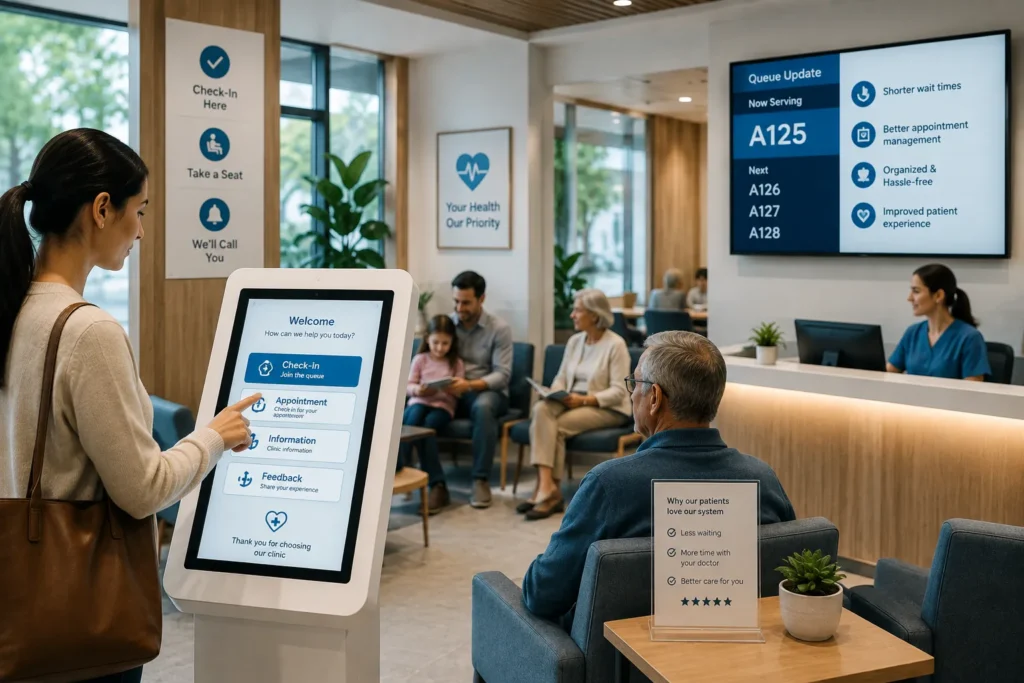
Hospitals are large, often confusing buildings for someone who’s stressed, in pain, or visiting for the first time. Digital wayfinding here focuses less on promotion and more on getting people to the right department, ward or clinic without needing to ask staff who are already stretched thin. This pairs naturally with patient queue systems, since both are about reducing friction in a visit that’s already stressful.
How it works alongside signage and queue systems:
Wayfinding, digital signage and queue management solve related but different problems, getting somewhere, seeing information, and managing a wait once you’re there. A hospital, for example, might use wayfinding to direct a patient to the right clinic, signage in the waiting room for general information, and a queue system to manage the actual visit once they’ve arrived. They don’t have to be bought as one bundle, but they’re designed to work together.
What digital wayfinding costs to run:
Same honesty as every pricing question on this site, nobody publishes a flat rate, because it depends on the number of kiosks, the size and complexity of the facility’s map data, and whether mobile access is included. A single-kiosk installation in a small facility is a different quote to a multi-kiosk rollout across a large hospital campus. If you want a real number, that’s a conversation, not a guess, and we’ll
walk through it properly based on your actual facility.
Questions to ask before choosing a supplier:
- How easy is it to update the map when a store, department or tenant changes?
- Does it support mobile-accessible wayfinding, not just an on-site kiosk?
- Can it integrate with your existing signage or queue systems?
- Who handles installation and mapping the facility initially?
- Is support based in New Zealand?
Talk to a Digital Wayfinding Specialist in New Zealand
Considering digital wayfinding for your mall, hospital or facility? EON Solutions supplies, installs and supports wayfinding systems across New Zealand.
📞 +64 20 4153 3999
📧 info@eonsolutions.co.nz
📍 Serving facilities nationwide across New Zealand
💬 WhatsApp us
📩 Request a Quote
Related Solutions:
Written by Tejas Chandegara, EON Solutions.
Frequently Asked Questions About Digital Wayfinding in New Zealand: